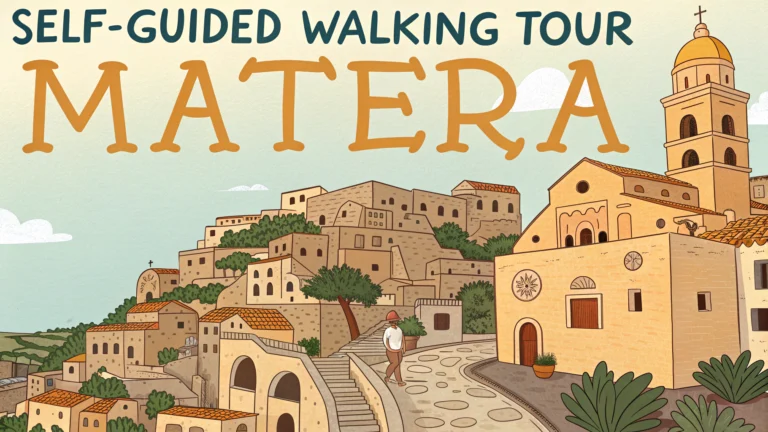
Walking through Matera’s ancient Sassi districts offers one of Italy’s most unique sightseeing experiences.
This self-guided walking tour takes you through the UNESCO World Heritage site’s cave dwellings, rock churches, and winding pathways that have been inhabited for over 9,000 years.
Starting Point: Piazza Vittorio Veneto
Begin your tour at Piazza Vittorio Veneto, Matera’s main square and meeting point.
Key Stops Along the Route:
- Palombaro Lungo – Ancient underground water cistern (€3 entrance fee)
- Cathedral of Matera – 13th-century Romanesque-style church overlooking the Sassi
- Casa Grotta di Vico Solitario – Preserved cave dwelling showing traditional life (€3 entrance)
- Chiesa di San Pietro Caveoso – Rock church with stunning valley views
- Monastery of Santa Lucia alle Malve – 8th-century rock church with frescoes
Practical Tips:
- Wear comfortable walking shoes with good grip for the steep, sometimes slippery streets
- Bring water – the walk takes 2-3 hours depending on stops
- Start early morning or late afternoon to avoid peak heat (especially June-September)
- Carry cash for entrance fees to caves and churches
- Download offline maps as cellular service can be spotty in the Sassi
Photography Spots:
- Belvedere di Piazza Duomo – Best morning light
- Via Madonna delle Virtù – Classic Sassi panorama
- Piazza San Pietro Caveoso – Sunset views of the ravine
Where to Rest:
Recommended Stops:
| Location | Type | Known For |
|---|---|---|
| Caffè Tripoli | Cafe | Traditional pastries, coffee |
| Area 8 | Bar | Panoramic terrace, aperitivos |
| Il Terrazzino | Restaurant | Local cuisine, cave dining |
Safety Notes:
- Streets can become slippery after rain
- Some viewpoints lack barriers – keep safe distance from edges
- Carry a flashlight for visiting cave churches
Emergency Contact: Local Police: +39 0835 378800
Tourist Information Office: Piazza Vittorio Veneto, 39 | Hours: 9:00-19:00 | Phone: +39 0835 680254
Food and Refreshments
Traditional Materan cuisine can be sampled at numerous restaurants throughout the Sassi. Local specialties include “crapiata” (mixed legume soup) and “orecchiette” pasta.
Local Delicacies to Try:
- Pane di Matera IGP – Protected designation bread made from local grains
- Peperoni cruschi – Dried red peppers, a regional specialty
- Caciocavallo cheese – Traditional aged cheese from Basilicata
Cultural Insights
The Sassi districts represent one of the oldest continuously inhabited settlements in history, transforming from a poverty-stricken area in the 1950s to a UNESCO treasure.
Historical Significance:
- Ancient cave dwellings housed families until the 1950s
- Featured in numerous films, including “The Passion of the Christ”
- Named European Capital of Culture 2019
Extended Activities
Nearby Attractions:
- Park of the Murgia Materana – Prehistoric caves and rock churches
- MUSMA Museum – Contemporary sculpture in cave settings (€7 entrance)
- Casa Noha – Multimedia exhibition on Matera’s history
Conclusion
A walk through Matera’s Sassi offers an incomparable journey through millennia of human history. The district’s transformation from ancient cave dwellings to a sophisticated tourist destination makes it a must-visit location in Southern Italy.
Remember to respect the archaeological significance of the site and follow local guidelines for preservation of this unique World Heritage location.
FAQs
- What is the best time of year to take a self-guided walking tour in Matera?
Spring (April-May) and autumn (September-October) offer the most pleasant temperatures and fewer tourists. Summer can be very hot, while winters are mild but can be rainy. - How long does it take to explore Matera’s Sassi districts on foot?
A thorough exploration of both Sasso Caveoso and Sasso Barisano districts typically requires 3-4 hours, though a full day is recommended to properly experience the cave churches and museums. - Are the walking paths in Matera accessible for everyone?
Many paths in Matera involve steep stairs and uneven stone surfaces. The historic Sassi districts can be challenging for those with mobility issues or strollers. - What are the must-see stops on a self-guided walking tour of Matera?
Essential stops include the Duomo (Cathedral), Casa Grotta, Piazza Vittorio Veneto, Church of San Pietro Caveoso, and the Palombaro Lungo underground water cistern. - Do I need to purchase tickets in advance for the cave churches and museums?
While not always necessary, it’s recommended to book tickets for popular sites like Casa Grotta and major rupestrian churches, especially during peak tourist season. - Where can I find the best viewpoints for photographing Matera?
The best panoramic views are from Belvedere Piazzetta Pascoli, Monastery of Santa Lucia, and the opposite side of the ravine at Parco della Murgia. - Is it possible to enter the cave dwellings independently?
Most cave dwellings are now private properties or museums. The Casa Grotta and various cave churches are open to the public with admission fees. - What should I bring for a self-guided walking tour of Matera?
Comfortable walking shoes, water bottle, sun protection, a map or offline GPS, and a camera are essential. Many paths are steep and slippery when wet. - Are there public restrooms available along the walking routes?
Public restrooms are limited in the Sassi districts. Most restaurants, museums, and cafes have facilities for customers. - How does the self-guided walking tour system work in Matera?
You can follow marked paths or use tourist office maps. Many landmarks have informational plaques, and several apps offer guided walking routes with historical information.