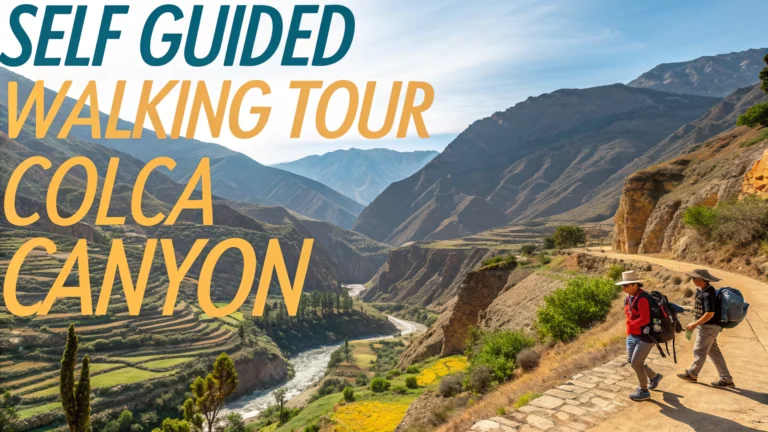
A self-guided trek through Peru’s Colca Canyon offers adventurous travelers the chance to explore one of the world’s deepest canyons at their own pace.
Quick Facts About Colca Canyon
- Depth: 13,650 feet (twice as deep as the Grand Canyon)
- Location: 100 miles northwest of Arequipa, Peru
- Best time to visit: April-November (dry season)
- Trek duration: 2-3 days recommended
- Difficulty level: Moderate to challenging
Recommended Route
Start your journey from the town of Cabanaconde, the main gateway to Colca Canyon treks.
Day 1
- Begin at Mirador San Miguel (6:00 AM start recommended)
- Descend to San Juan de Chuccho (3-4 hours)
- Continue to Sangalle/Oasis (2-3 hours)
Day 2
- Start early (4:00-5:00 AM) for the climb out
- Ascend to Cabanaconde (3-4 hours)
Essential Packing List
- Sturdy hiking boots
- Sun protection (hat, sunscreen, sunglasses)
- 2-3 liters of water
- Light snacks and energy bars
- Cash for accommodations and food
- Basic first aid kit
- Flashlight/headlamp
- Light jacket (temperatures vary significantly)
Transportation Tips
Regular buses run from Arequipa to Cabanaconde (6 hours, $6-8 USD).
| Bus Company | Departure Time | Price |
|---|---|---|
| Andalucia | 3:30 AM | $7 |
| Reyna | 5:30 AM | $8 |
Accommodation Options
- Llahuar Lodge – Basic rooms with hot springs access ($15/night)
- Sangalle Oasis – Simple bungalows with pool ($12/night)
- San Juan de Chuccho – Family-run homestays ($10/night)
Safety Tips
- Register your trek at the tourist office in Cabanaconde
- Download offline maps before starting
- Avoid hiking alone if possible
- Start early to avoid afternoon heat
- Acclimatize in Arequipa for 2-3 days before the trek
Emergency contact: Cabanaconde Police Station: +51 54 767809
Trail Markers
Look for red and white paint marks on rocks to stay on the main trail.
Cost Breakdown
- Bus transportation: $15-20 round trip
- Accommodations: $10-15 per night
- Food: $5-10 per day
- Entry ticket: $20 (purchase in Chivay)
Remember to carry your passport as it’s required for purchasing the canyon entry ticket.
Cultural Highlights
Along the trek, hikers encounter traditional Andean villages where locals maintain centuries-old agricultural practices on ancient terraces. Many communities welcome visitors with authentic home-cooked meals.
Wildlife Spotting
- Andean Condors (best viewed at Cruz del Condor)
- Vizcachas (similar to rabbits)
- Giant Hummingbirds
- Andean Fox
Alternative Routes
3-Day Circuit
- Day 1: Cabanaconde to Llahuar
- Day 2: Llahuar to Sangalle
- Day 3: Sangalle to Cabanaconde
When Things Go Wrong
- Local guides available for hire in Cabanaconde ($20-30/day)
- Multiple exit points along the trail
- Basic medical facilities in Chivay
- Mule rescue service available ($50)
Conclusion
The Colca Canyon trek offers an extraordinary blend of natural beauty, cultural encounters, and physical challenge. With proper preparation and respect for the environment, this self-guided adventure provides an unforgettable experience in one of Peru’s most spectacular landscapes. The trek’s flexibility allows travelers to customize their journey while maintaining safety and comfort throughout the experience.
For the latest trail conditions and updates, check with the local tourism office before departing.
FAQs
- What is the best time of year to do a self-guided trek in Colca Canyon?
The best time is during the dry season from April to November, with optimal conditions between June and August. The weather is stable with clear skies, though nights can be cold. - How long does it take to complete a self-guided trek in Colca Canyon?
A typical self-guided trek takes 2-3 days. The most popular route is a 3-day trek from Cabanaconde to Sangalle (Oasis) and back. - What is the elevation of Colca Canyon and how deep is it?
Colca Canyon reaches depths of 3,270 meters (10,730 feet), making it twice as deep as the Grand Canyon. The rim elevation is approximately 3,600 meters (11,811 feet) above sea level. - Where can I see the famous Andean Condors in Colca Canyon?
Cruz del Condor viewpoint, located between Pinchollo and Cabanaconde, is the best spot to observe condors, particularly in the early morning hours between 8:00 AM and 10:00 AM. - What essential items should I pack for a self-guided Colca Canyon trek?
Essential items include a good map, plenty of water, sun protection, warm layers, sturdy hiking boots, cash, basic first aid kit, and a headlamp for early morning starts. - Do I need a permit or guide to trek Colca Canyon independently?
While you don’t need a guide, you must purchase a Colca Canyon Tourist Ticket (boleto turístico) which is valid for several days and can be bought in Chivay or at control points. - What is the difficulty level of the trek?
The trek is considered moderate to challenging, with steep descents and ascents. The final ascent from the canyon floor can take 3-4 hours and involves an elevation gain of about 1,100 meters. - Are there places to stay and eat along the trek?
Yes, there are basic lodges and homestays in villages like Sangalle (The Oasis), San Juan de Chuccho, and Cosñirhua. Most provide meals, but it’s advisable to book ahead in peak season. - How do I get to Colca Canyon to start the trek?
Most treks start from Cabanaconde, which can be reached by bus from Arequipa (6-hour journey). Buses run regularly from Arequipa’s Terminal Terrestre. - What is the best way to acclimatize before the trek?
Spend at least 2-3 days in Arequipa (2,335m) before heading to Colca Canyon. Some travelers also stay one night in Chivay (3,635m) for additional acclimatization.